Chimera
Adam Crowley and Misha Kligman
-
4th Floor, 1106 Santa Fe St
Kansas City
Taking on themes of inherent banality, Adam paints quiet scenes devoid of people: vases, a solitary black lamp, some trash stuck in trees. These repetitions on common occurrences are not trying to trick. They are made in earnest by someone who has taken time to capture small, glossed-over moments. And if you look long enough they start to show their precariousness. They are humming with what could be edginess - hinting at an uncaptured, foreign force. Misha's hazy and rougher cardboard-adorned-figures are not really people. They are unabashedly emotional like us. Rage, desire, pride and sorrow are on bold display. They may be from the present, but its uncertain. At first glance they look European - on a second look they could be from any city. Even though most are painted with a quick touch they seem to be at a stand-still. It's hard to imagine them in a previous state of being, what is being shown is the truth. It feels like they have no choice.
In conversation
Adam
Last we talked you mentioned painting people, and possibly places for them to inhabit. A lot of my stuff has to do with place and sort of traces of humanity.
Misha
I’ve been painting mostly people. You’ve been painting mostly objects. Both are trying to find strangeness in the familiar.
Adam
Yes, absolutely. Trying to express the sort of dissonance of being, or living or observing.
Misha
I think my recent work that I would be keen on showing has an underlying sense of violence or maybe dissonance too. Maybe sometimes only in the way it’s painted. Instability too. and the melancholy is more distant now not as fore-fronted. Melancholy of my older work is being replaced by rage and a kind of deliberate fucking around.
Adam
I think about the dissonance of our culture a lot, as well as dissonance as it pertains to the domestic existence.
Misha
What quality are you looking for in your work? When in your view is it doing that thing you’re after?
Adam
I think I have been looking for poignancy, or trying to imbue the object or scene with a sense of, not holiness, but something akin to that. But with the knowledge of these moments set against the backdrop of the din of contemporary existence. The dissonance idea has come to light in the last still life I worked on, and this one that I’m currently working on. Dissonance in paint application, overall painting structure, etc… combined with more measured rendering. Scrape them up together and see what happens. Holiness with the understanding of the failure of holiness.
Misha
I’ve been interested in the concept of holiness as well. I think I’m painting people who are in my understanding capable of anything. They’re not good nor bad. They’re not even trying to be good, I think perhaps holiness as something unattainable? Whatever I’m making now is leaning heavily into the profane. So again, in many ways we’re making very different work. I’m abusing color right now too. Things are seemingly too colorful and arbitrarily colorful. What about the word “numinous” ? is that something you think about or interested in?
Adam
Numinous is a word I haven’t come across, but something I will look more into. And yes, that idea of unattainable holiness. Like a yearning for romantic ideology; the spiritual, the anti-scientific or technologically progressive, but with the understanding that it isn’t achievable.
Misha
It is also just being about how paint and painting can seemingly change the nature of representation and what is represented becomes untrustworthy as well as suggestive of certain kind of truth. What happens to representation when it’s “stretched” and played with, when it’s plasticity is situated at the center of what the work is about.
I’m inventing most of it, the people in my paintings right now are without identity - they’re surfaces that suggest a sense of being but that being is only in the paint.
Their existence outside paint is questionable. That move has given me a sense of freedom to not try to suggest these people are a part of any kind of group or belong to any kind of history.
I think Adam with your work there is a kind of directness, maybe honesty too and love of observation, contemplative quality. Not trying to complicate things beyond what they already are which is plenty. Am I right here?
Adam
The contemplative is for sure a part of painting for me. I am interested in engaging with the physical world and maybe the thought that I am inhabiting a particular part of the world that has existed for a long time, but my particular existence is a momentary one. But with my photo based work I think I can delve into that question of representation and shaky nature of the image. I can say that the perceptual still lives are honest, but these latest ones with the dissonant color-mark making maybe moves away from honesty? Or maybe questions it?
Like that old Ryman quip that he is the most realistic painter of them all because his paintings don’t fool your eye into thinking you’re looking at a vase of Flowers or whatever. Maybe im trying to bring some equivocation into it. Like granting the viewer the contemplative, but then cutting into it with the dissonant. The struggle for the holy while understanding the impossibility of finding it. Can a painting express both the yearning for God and the knowledge of its own shortcomings?
I like this idea of your people being without identity. One of the main reasons I haven’t incorporated people into my paintings is just that; once a person is introduced, an identity is as well. It puts the baggage of humanity on the painting.
My paintings have the stuff of people, plastic bags, broken furniture, vases of flowers etc… all of which can set a stage for a story, but hopefully without all the emotional hang ups of a portrait.
What is it that keeps us painting? These days there are myriad different methods of expression, why keep coming back to painting? What can it still offer?
Misha
I paint because there are depths to be explored and I know it. Once you see great art it gets under your skin and from that point on you chase that feeling however you can. Another angle is we both use very basic anonymous things in the work: for me lately it’s baseball hats, plain t-shirts, very basic landscape elements like satellite dishes, fences, plastic chairs, blocky buildings. The everydayness of that… it’s interesting - I’ve been pursuing the spiritual dimension of painting for a long time. The current work is taking me away from it and I don’t quite understand why but I’m following it. I think I’ve realized there have been missing pieces that need to be included that I’ve not paid enough attention to: rage, the erotic, violence of daily existence, human appetites, the transgressive.
Adam
It’s interesting, the use of the everyday object in our work, because we are right now maybe interested in different topics, but using similar themes to consider them. I don’t work much in rage and violence, or transgression, at least for the time being, but we both have found an interest and a way to interpret both of our specific pursuits. I’ve been thinking a lot about the necessity of beauty in the modern landscape. I have not, however, settled on a definition of what beauty is—or its availability these days. I feel like I’m searching in the dark sometimes, going back and forth between beauty and ugliness, and wondering if they can exist simultaneously in a painting as they do in the world.
Misha
Do you think Vermeer or Morandi, or let’s even say Richter, have the quality you seek in your work? Or do you think something is missing in that work? I sense reverence for the reality of painting in those people. In turn I think it evokes or triggers in me a contemplative response both of the painting and reality as such. It’s in the silence of those paintings.
They’re about something and about nothing at the same time. What I find fascinating about god in art is that it’s so taboo. It immediately positions the work as something outdated, obsolete, even not cool. Which I find to be a challenge to push against. Taboos in art interest me.
Adam
Morandi and Richter for sure, though I feel like Richter has really straddled that line between contemplation and violence at times with his paintings of Holocaust, Baader Meinhof, or the scraping away at the paintings themselves. I like Peter Dreher a lot, and Chardin, who both deal in reality but push it, at least with Dreher, towards a more philosophical direction. Also I love silence in paintings. Actually one of my most cherished experiences with a painting was with a Vermeer at the Met. Girl Asleep at a Table. I like silence with the acknowledgement of dissonance, but maybe the act of painting silence acknowledges the dissonance of the world? This is a tributary that I have not yet followed… Who do you look to? We’ve talked about Kiefer before, and Enrique Celeya, are there any classical painters that you’re particularly drawn to? As far as spirituality goes I can think of a few, not sure about taboo, though I suppose Goya could fit that pathway.
I have been reading Guston this morning and a couple things stuck out to me. This is apropos of nothing except it seems somewhat along the lines of our conversation and just thought it might be interesting.
The first is he talks about making a duplicate, or a golem in painting. He’s referring to a conversation he had with R. B. Kitaj.
Making a painting or something sort of parallel to the real world. He mentioned Giacometti wanting to make duplicates of his sitters, and Guston is referencing his own paintings of painters. He also mentions Della francesca and Ucello, as he is want to do, but I thought that idea of sort of parallel, never converging, maybe a little uncanny was an interesting concept.
Secondly he was talking to Harold Rosenberg about making choices in painting, and the idea about not making choices at all, but being driven by the painting itself. Rosenberg asked if he was a “victim of mysterious forces” and a “victim of a sublime executioner” which is making me think of kind of what forces are driving the painting. The muse is antiquated, but maybe its a build up of prior knowledge or experience with art that drives the hand?
Misha
This line of thought interests me. Ive long considered and have been after the idea that art is both better than me and knows more than me. The question whether the painting is simply what you put into it or does it have the capacity to be more? If it’s more, then what is it? What part of it are you not responsible for? If not you, then who or what? Leonard Cohen has his answer to that and so does Enrique Celaya. Both point to things outside us, out of our control and not of our making. So you’re dictated what to make in a way. You’re a medium. Bob Dylan also spoke about that.
That’s how I arrived to an understanding of an artist as a kind of mystic. Celaya proposes artist as prophet which in his view goes further than the mystic. The prophet returns with something to be revealed to the world - the mystic does it for himself.
But both have to leap into the unknown - and it is a leap of faith.
Lucian Freud spoke about being only interested in doing what he can’t do - the impossible. The possible isn’t material for art, it is forged from the impossible - from that which is, from its very onset, a failure.
So art has to do with with a known undertaking of that impossible which can only be a failure, but is done as a leap of faith into the unknown.
Adam
Yes, this is exactly it! The fact that all of these artists are trying to tap into whatever that is, that trying to grasp that unknown current proposes a shared knowledge of understanding or attraction to the current itself. And the striving and ultimately failing is something I feel very acutely. Could add Auerbach, Celmins, probably a lot of romantics to that list as well. It’s a strange thing to be searching for because it feels like religion, or at least the essence of religion.
Misha
I would agree. It’s a religious search in its essence. But in contrast to religions - this search isn’t dogmatic and isn’t based on any unquestionable truths. The truth the artist is after is being itself that is attempted to be brought out through the clarity of the artwork. But this truth (being) is illusive and changes guises and has to be chased according to the times one is living in. We’re all part of the condition and can’t pretend to become romantic painters. Or primitive painters or whatever.
And the thing I appreciate about somebody like Leonard Cohen is this search isn’t dogmatic and is being conducted through the muck of the daily life and not outside of it (as in the minimalists.) Through the subjective towards the objective.
Adam
This is very well said. Do you think this truth is a sort of collective consciousness of the contemporary era? Trying to tap into the base drives of humanity? Or looking for clarity from the baseness? Is it the same truth science looks for? Science uses methodology to prize apart the structure of the world, and art looks to something less concrete, so grappling with consciousness?
Not really in a Jungian way, that there is some vast underground ocean of consciousness which we pluck from, but the foundations of, maybe, perception of what we are?
Misha
Celaya (who’s a former physicist) calls it the “whisper of the order of things.” I really like that description because it makes me think it lies outside of time and outside our human condition. And yes, something to do with consciousness, I feel. So not the zeitgeist.
Adam
Right, not the spirit of the times or anything. That is a good definition, I know Celayas work a little, but haven’t dug too deeply.
Misha
I think he’s the most important artist of the 21 century so far. His view of art is revolutionary in the way I think - it must evolve in order to jump levels to what’s next for us all. He’s not a cynical academic about art.
His books are worth reading. I have a few you can borrow if you’d like. Art and Mindfulness is a good intro into his views. Collected Writings and Interviews Volume 1 is just amazing. For me it turned art on its head.
I’m circling back to see if I missed anything from the long thread. You’ve said many interesting things and I’m trying not to lose track of them.
I’ve not seen the work of Peter Dreher before, just looked it up. I can see how he fits into the lineage of painters like Celmins that resonate with you. Probably Agnes Martin is in the same lineage. The idea of silence and a kind of cool painting (not hot painting, nothing extra emotional) is something I can see in your work. A contemplative cool (as in distance) practice of repetition, ritual and discipline. Also a practice of denial of visual pleasure.
So in many ways we’re opposing sides of painting. I’m into color, violence of mark-making, paint as meat, overflowing feeling, and transgression. These are things I’ve avoided and denied in my work but not nowadays.
Adam
Yes for sure. I am wary of exuberant emotion in my work, and I am definitely drawn towards the silence. But the silence in relation to the cacophony. And yes, Dreher and Celmins and Richter and Martin. Martin can be seen also as searching for those big foundational structures of existence, more so than other minimalists. Dreher opened my eyes to what the act of painting could be. Painting as endurance, meditation, rationalization.
So yes I think we are making different work for sure, but asking similar questions, or maybe asking different question about the same problem.
I’ve thought about this before. I think its the entirety of a painters work that chips away at the big questions, and you can find the chisel marks in the individual works. They are, in the end, hand made objects and fail to live up to the immensity of questions like the order of the universe, but the oeurve of an artist who is dedicated to whatever question they want answered is an inroad into the overall condition of existence and consciousness.
The works themselves are tangible and therefore fallible, but the creative endeavor put towards these questions is what moves the needle.
Misha
I may have said this to somebody before: we go to the studio searching for big things, but in the end we encounter a painting. And that condition of wanting to make people cry and the pursuit of something monstrously large is always against the fact that it’s only a painting.
So a paradox I guess.
✳

Plastic Bag,
Adam Crowley,
2024,
Watercolor and tempera on panel,
9 x 12 in

Chimera
, Installation View

Balloon,
Adam Crowley,
2025,
Watercolor and tempera on panel,
10 x 10 in

This is What It's Like to be Alive,
Adam Crowley,
2025,
Oil, charcoal, colored pencil on paper,
27 x 20 in

The Problem of Existing,
Adam Crowley,
2025,
Oil and charcoal on canvas,
50 x 45 in
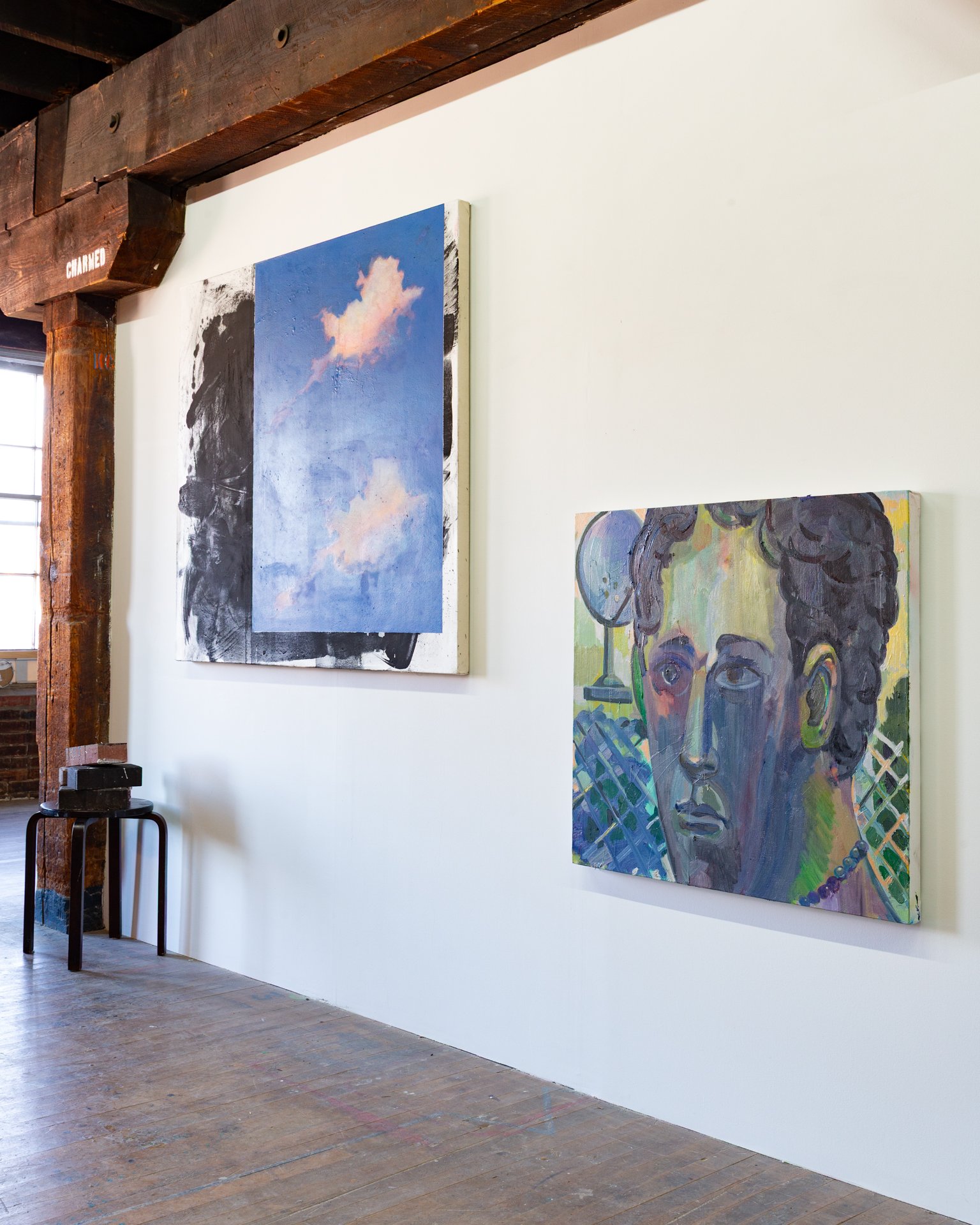
Chimera
, Installation View

Divination,
Adam Crowley,
2025,
Oil and graphite on paper,
39 x 27 in

Chimera
, Installation View

The History of Everything,
Adam Crowley,
2025,
Oil on paper,
22 x 15.5 in, 22 x 15.5 in

Chimera
, Installation View

Carefree Still Life,
Misha Kligman,
2025,
Oil, spraypaint, gesso, cardboard and wood on canvas,
16 x 20 in

Citizen I,
Misha Kligman,
2025,
Spray paint, oil and cardboard, and paper on canvas,
14 x 16 in

Citizen II,
Misha Kligman,
2025,
Spray paint, oil and cardboard on linen,
12 x 16 in

Chimera
, Installation View

Sick Boy,
Misha Kligman,
2025,
Spray paint and oil on canvas,
16 x 20 in

Chimera
, Installation View

Chimera
, Installation View

Pedestrians,
Misha Kligman,
2025,
Spray paint and oil on canvas,
27 x 30 in

2 pm (Lunch Break),
Misha Kligman,
2025,
Spray paint and oil on canvas,
24 x 26 in
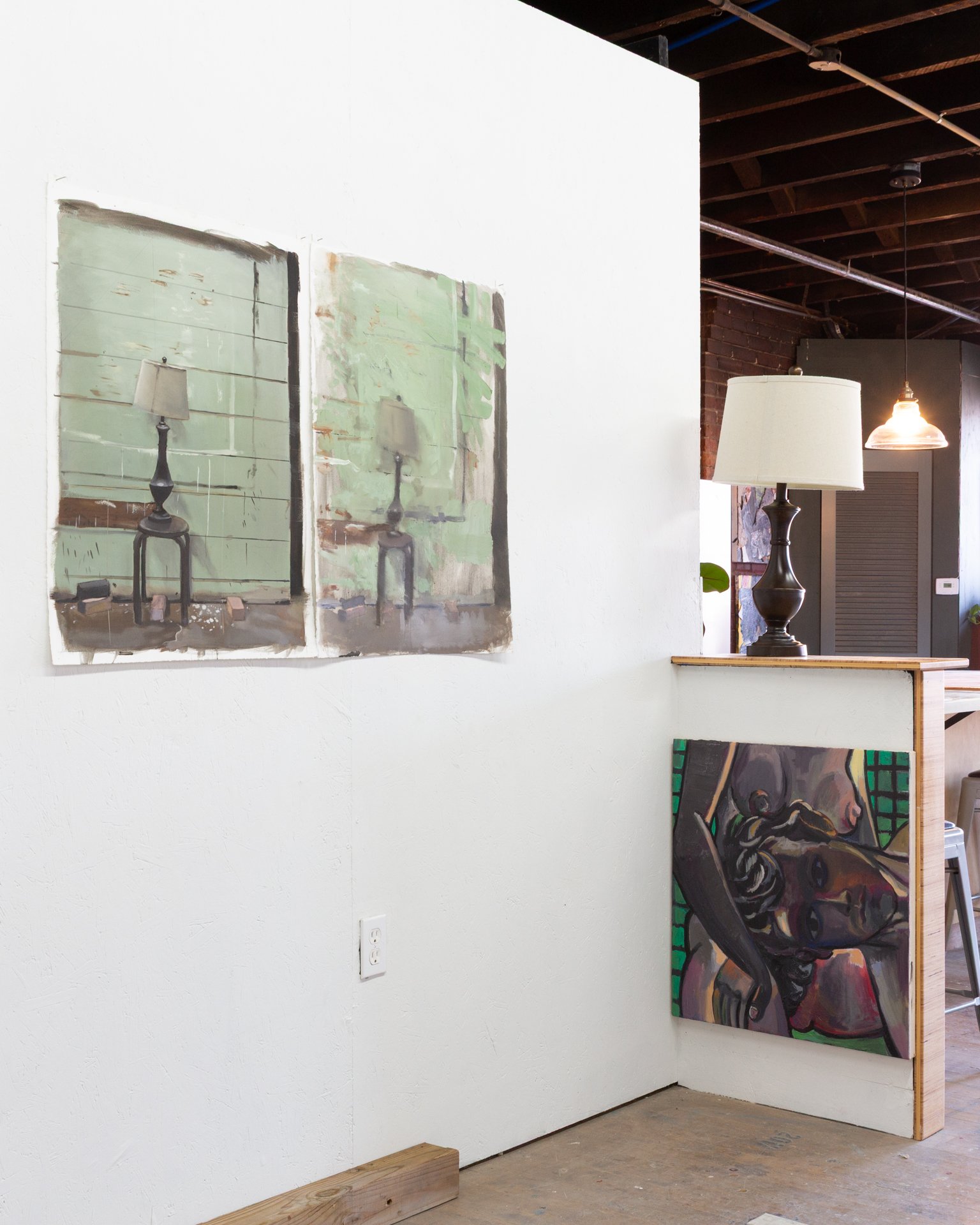
Chimera
, Installation View